RSECon26 Retrospective
RSECon26 in Sheffield was a fantastic celebration of research software engineering from across the UK and beyond. It was particularly special with this year being the 10th anniversary of this annual celebration of the profession and everything that’s been achieved. I’d definitely say it was the best one yet, despite the difficulties of the UCU boycott, so I thought I’d do a small retrospective capturing my experiences and the things that particularly stood out.
The biggest main reason I enjoy this every year, and it took me a while to realise this, is that, unlike a lot of other academic conferences, at RSECon nobody is trying to get a leg up on anyone else or prove themselves the best, rather it’s a community that’s coming together to share what they know and collectively raise one another and the community up. That’s what makes it, I think, such a wonderful event to attend every year.
What I did
RSECon Programme Committee
My RSECon26 actually began well in advance of September with my involvement as poster chair on the committee so this began back in 2025. Overall I’d say it’s been an amazing experience meeting a huge number of people from across the UK and beyond and expanding my network within the RSE community and so I would definitely encourage anyone who’s interested in doing it for 2027 in Edinburgh to get involved. In particular for me I think the biggest takeaway was in leadership and particularly about being able to trust those that I’m working with, to share in the responsibilities for the conference and not to feel guilty if they were doing something that I wasn’t.
This year also saw the introduction of a collaboration between RSECon and the JOSS (the Journal of Open Source Software) . An idea of conference chair Romain, under this track people could submit a talk to accompany a paper in JOSS, with papers being marked for a special issue. As an editor for the journal I helped with handling the submissions as part of the programme committee.
Tuesday: Leaders SIG
My RSECon week began on the Tuesday by attending the leaders special interest group (SIG) meeting. Chris Edsall and I had a lightning talk about effects of generative AI on the recruitment process and how to handle the changes. We discussed some of the challenges we’d come across in a recent round including some of the sort of signals we were seeing and how older processes used for hiring and recruitment are no longer suitable for the changing landscape of applications. This was sparked a lot of further discussion from other groups who’d seen similar things in their hiring processes and it was good to hear how others were adapting to handle these changes. Some suggestions were moving from free-form CVs to predefined application forms, introducing multiple rounds and/or in-person interviews, and
Another lightning talk came from Alex Lubbock at the Rosalind Franklin Institute I really enjoyed hearing about his experience moving from senior RSE to team lead; what he’d expected, what had taken him by surprise, and the challenges along the way. Sharing his experiences I found this to be a really honest talk that was also incredibly relatable as someone who’s going through a very similar process myself at the ICCS.
For the final part of the session I was honoured to be invited to be part of a panel on “Debunking the Myths of RSE Leadership”. A few key takeaway points from this discussion I would pick out:
- A leader is not simply someone that manages a team of RSEs, as I might have thought two years ago, but is anyone who’s working to further the community of research software engineers in any way. Examples include leading or building special interest groups, pushing for change within their institutions and beyond, and setting up and running events bringing those in the digital research space together to build something more.
- Interpersonal skills are key to RSE leadership. Something that my other panel member Kirsty Pringle and I both advocated for was learning to speak to people in their own language which really helps with building trust and helps get things done.
- It’s important to let your team members make mistakes and use them as a learning opportunity. At the same time you should always have their back and make sure that you help them learn, not simply let them struggle.
- Finally, a point of reflection for myself was that early on in my career I often wanted to say yes to everything and grab every opportunity I could. However, a change that comes with moving into leadership is learning what opportunities are of most value, and when to say yes, because you can no longer do everything and you find more and more people approaching you with opportunities. Learn what to say yes to, but also what you can offer to those who are following behind you to help them build their own careers.
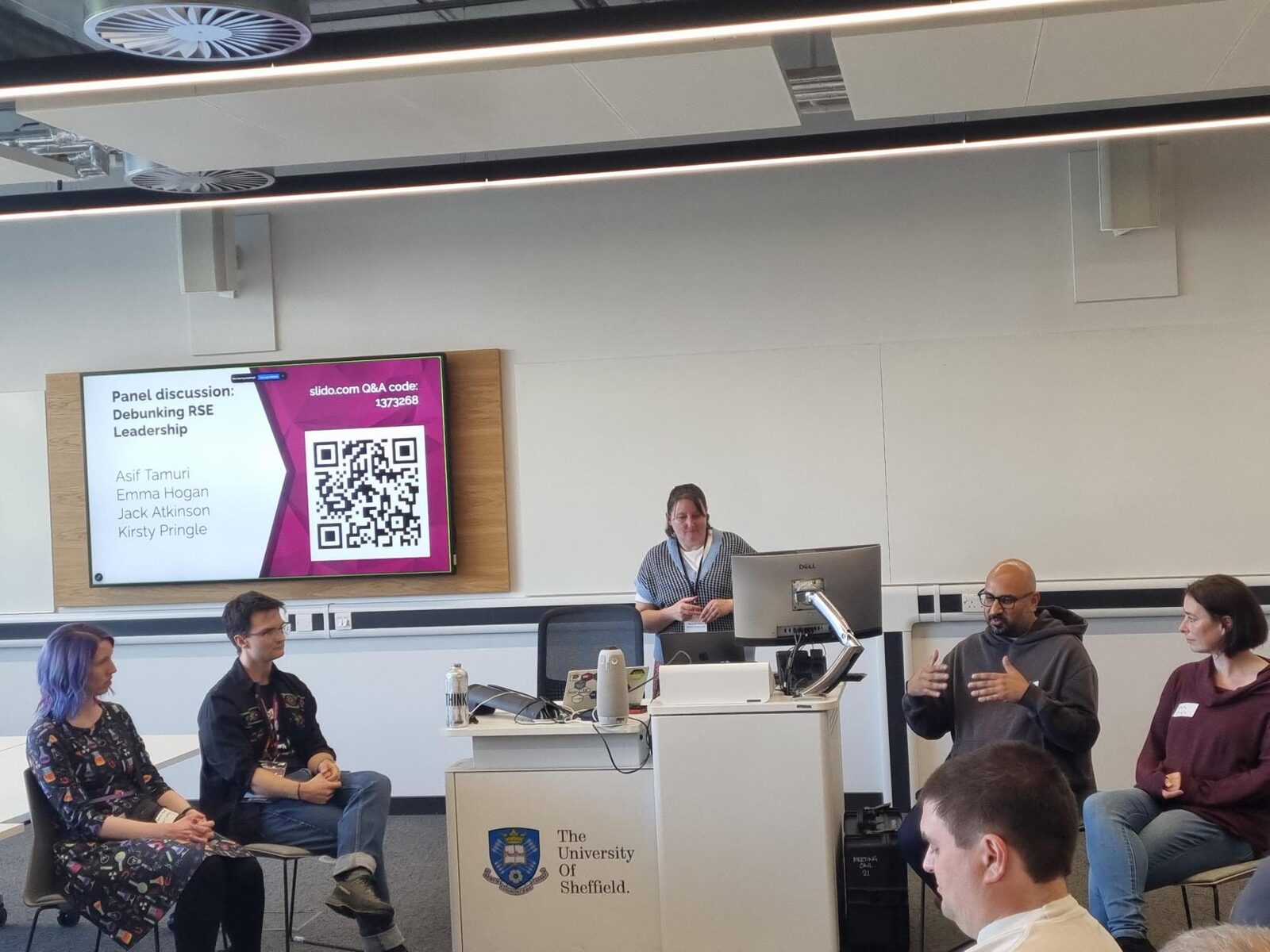
On the ‘Debunking the Myths of RSE Leadership’ panel at the Leaders SIG. Photo by Marion Weinzierl.
Wednesday: Posters, dinner, and awards
The conference proper began on Wednesday. Much of my attention was taken up ensuring everything was ready for the poster session that I was in charge of at the end of the day. This also featured a poster that I had helped prepare on the Journal of Open Source Software , introducing it to those who were new to the concept but also discussing how things have changed at the journal in response to submissions that are written using generative AI.
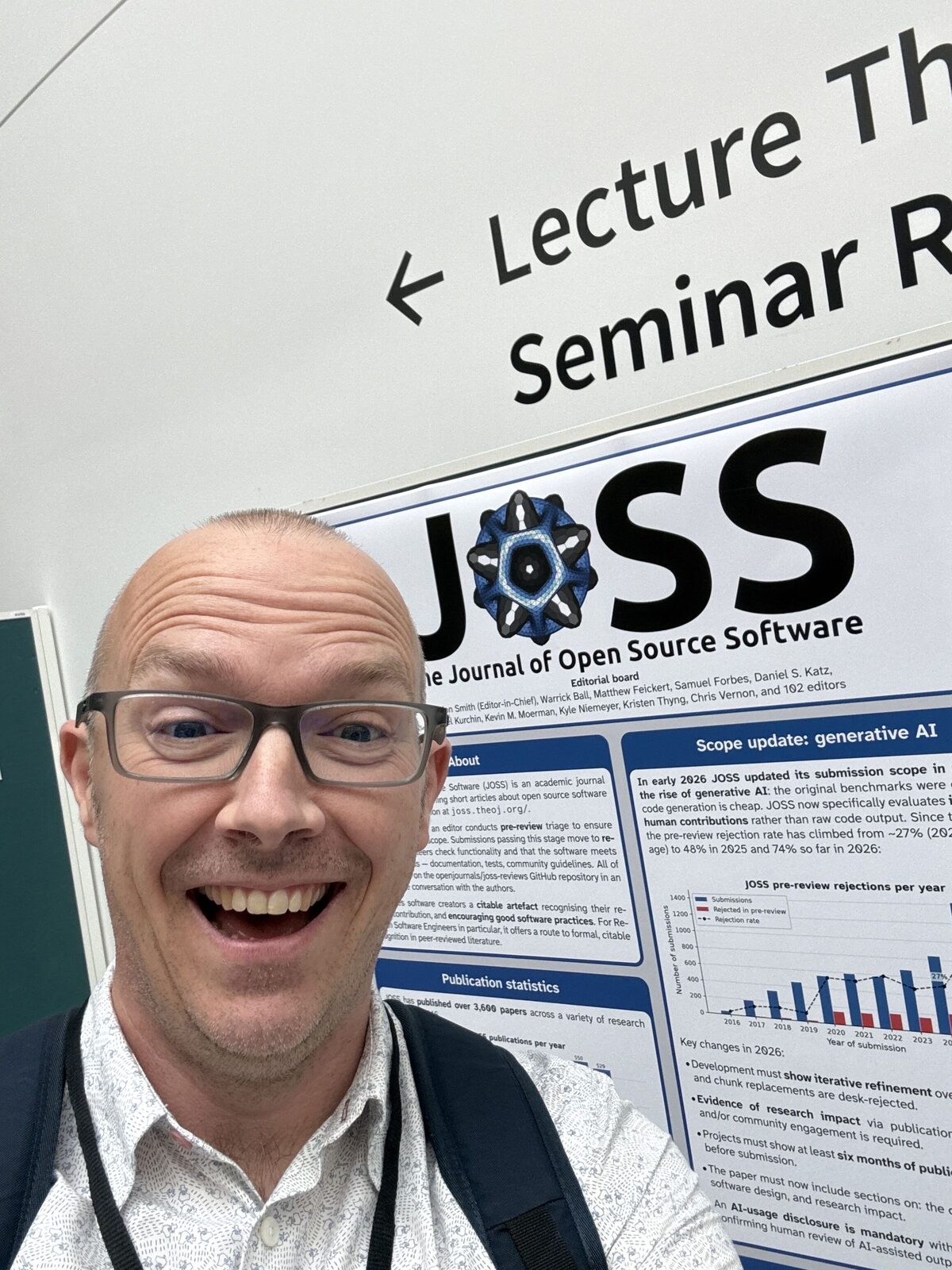
Outgoing JOSS editor-in-chief Arfon Smith at our JOSS poster.
The poster session went really well and there was a fantastic quality of submissions making it incredibly difficult to choose the awardees for best posters at the end of the day.
Following the sessions and the poster reception we headed to dinner where I was delighted to hear from Dylan Beattie giving us an overview of Rockstar 2.0 after dinner. When I originally proposed him as the after dinner entertainment it was purely selfish motivation to hear someone I think gives fantastically entertaining tech talks. If you’re unfamiliar I particularly recommend his song re:bass (if git was music) that I use when teaching git.
The real highlight of the dinner was the awards section where ICCS were awarded the RSECon Community Award for Training and Education in recognition of the teaching work we do, the training materials we’ve produced, and our endeavours throughout the year at our annual summer school, various conferences, and with other groups. These all aim to teach share research software skills to researchers and change the culture of academic research when it comes to software. Following this award it was really nice to attend the teaching and training workshop on Thursday, run by Sarah and Esther, and share some of our ideas and experiences whilst also getting inspiration for ways we might further improve training provision at Cambridge.
In addition to ICCS’s award my co-principal Marion picked up two incredibly well-deserved awards: the first one for Impact on the RSE community and the second being the Claire Wyatt Outstanding Contribution award. Both of these were incredibly well deserved and, based on the number of nominations, I’m not the only person who can say that they would not be doing everything listed in this post and beyond without Marion’s mentorship and encouragement
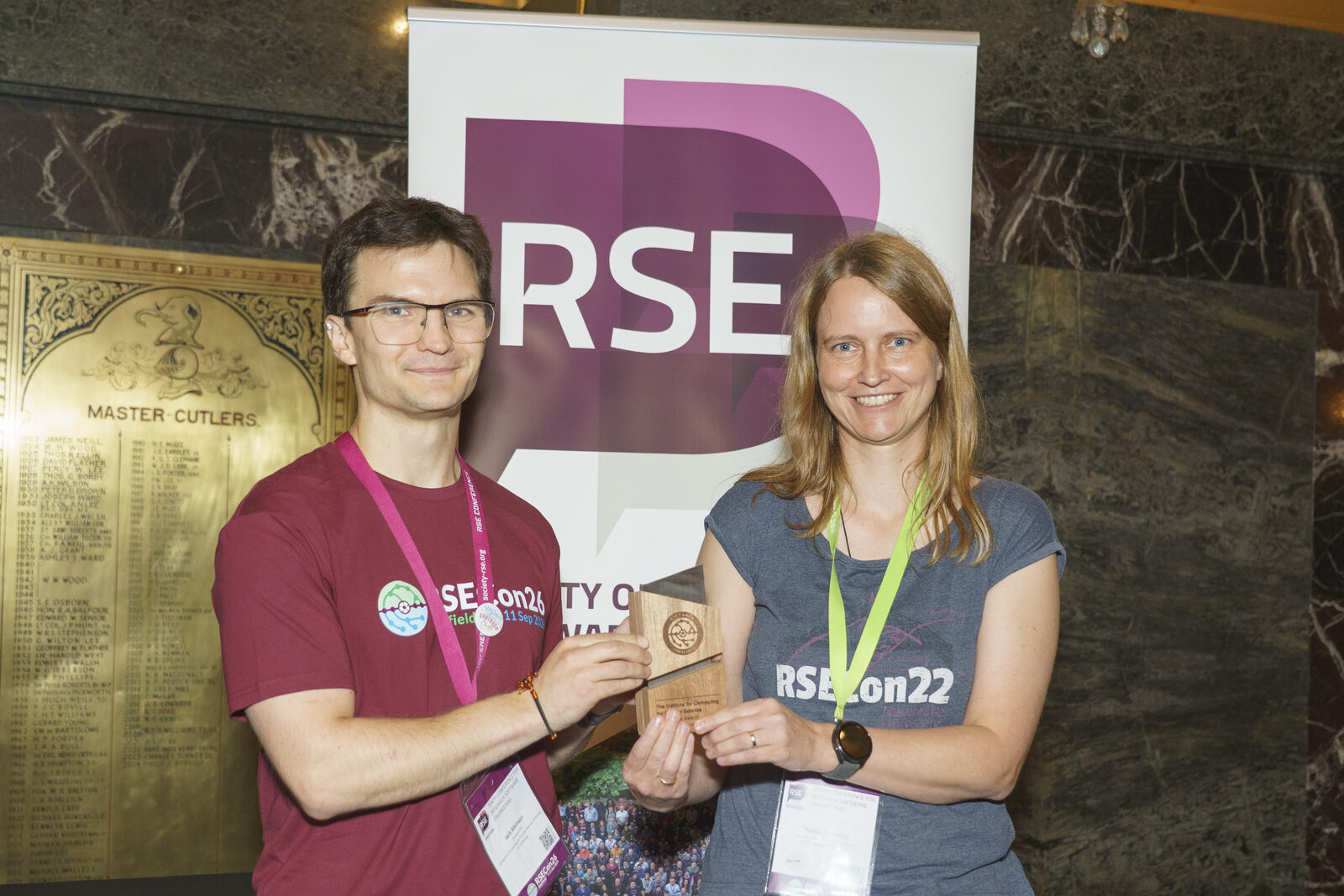
Marion and I receiving the teaching and training community award. Photo by Society of Research Software Engineering /Dominic Lipinski, licensed under CC BY-NC 4.0 .
Thursday: Research software in the community
With the poster session out of the way, my big obligations to the conference had finished, but that was by no means the end of my involvement for this year.
Day two began with an excellent presentation by my colleague Sam Avis talking about some of the work we’d been doing to build software making it easier for researchers to run different tropical cyclone tracking algorithms whilst also raising the standard of the output data from those algorithms to be fully FAIR and reusable tagged with appropriate metadata for the field. Sam did a fantastic job of presenting not only the TCTrack software , but also the journey we’d had in developing it, interacting with the researchers and bringing both technical and domain knowledge that is the specialism of the ICCS to the problem.
In the afternoon, I chaired a session on research software in the community with several interesting talks. In particular, it was nice to hear from Dan Katz about the deeper details of software publication metrics and to understand where some of the changes to the Journal of Open Source Software, discussed in my poster, had their foundations. It was also good to hear from Neil Chue Hong about the Research Software Maintenance Fund (Round 2) and the data that had been gathered. Whilst we weren’t successful with FTorch ,i it was good to hear that the call itself had been hugely successful and hopefully there will be future rounds of this raising the appetite and demand for funding this sort of work.
Friday: Geoscience SIG Meetup
Finally, on the Friday, I was a co-organiser of the Geoscience Special Interest Group Meetup where we had the AGM, a series of lightning talks, and a panel discussing career development and the nature of domain specialist RSE groups. I was on the, again finding myself alongside Emma Hogan from the Met Office, along with Mark Richardson from CEMAC and Tobias Ferreira from the National Oceanography Centre. Slides from the session can be found on Zenodo .
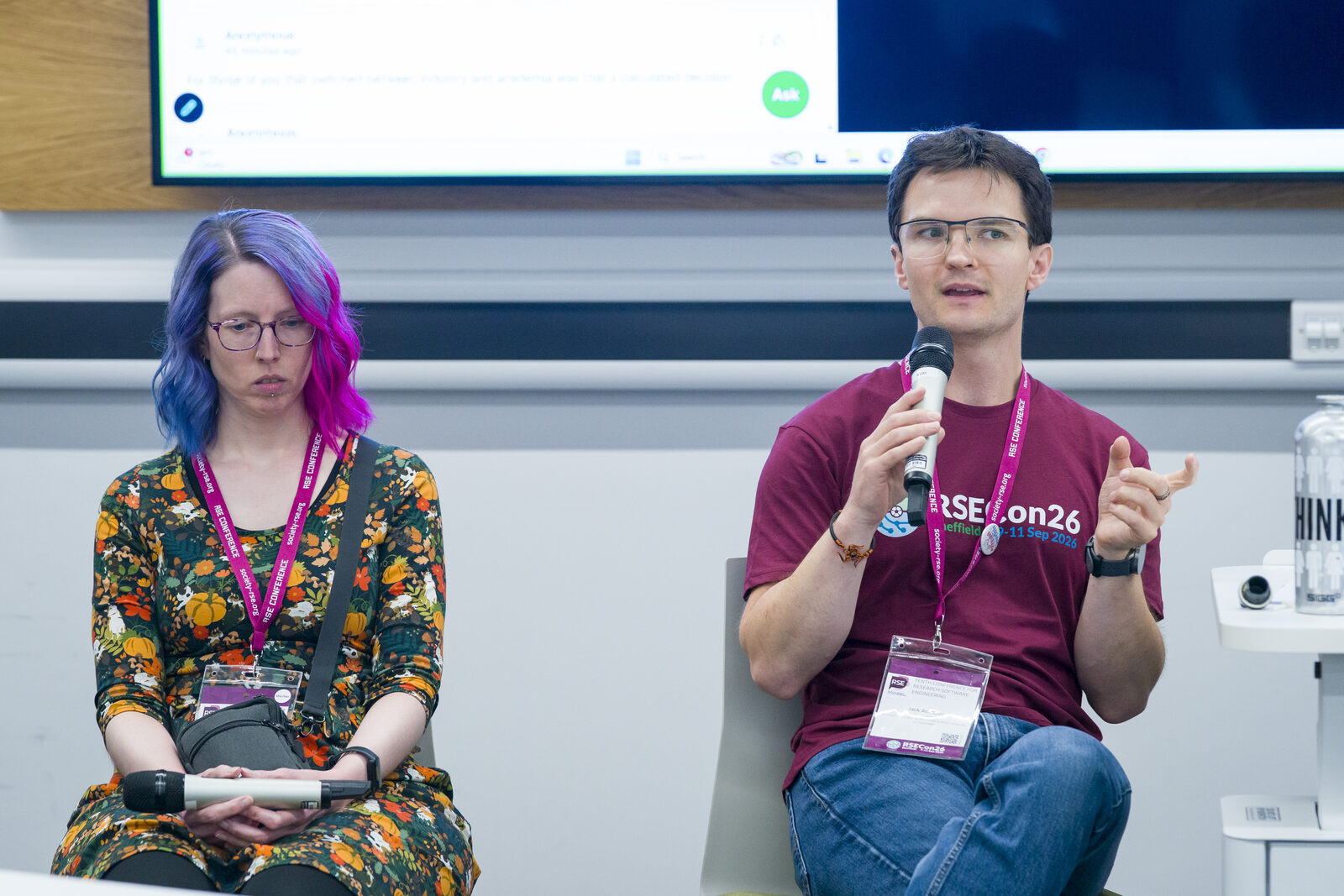
With Emma Hogan on the Geoscience SIG panel. Photo by Society of Research Software Engineering /Dominic Lipinski, licensed under CC BY-NC 4.0 .
Highlights
Whilst RSECon26 was an extremely busy three days in terms of organisation, I did manage to spend some time attending talks and workshops. Here I list a few of my particular highlights.
Liam Pattinson’s talk on Fortitude in the Fortran session. It’s been fantastic to see how this tool has developed from discussions with Liam about a conceptual idea to something that’s being used by multiple groups around the world to improve the quality of their Fortran code. They are making fantastic use of their Institute of Research Software Fellowship in promoting and building a community.
I also really enjoiyed two of the keynotes this year. First Kirsty Pringle’s “We’ve Built a Great RSE Community. Now Let’s Try to Save the Planet.” which discussed a topic close to my heart in much of my work. It set the scene well for next year’s conference theme whilst also propmting me to take further action on environmental initiatives in the ICCS RSE Team – I will decided that we will work towards the Bronze GreenDiSC Award from October. Secondly Arfon Smith’s “Where does the rigor go? Research software and the future of trustworthy science.” discussing his vision of the future with the rise of generative AI. I’ve discussed this topic with Arfon through both JOSS and ICCS/VISS before, but it’s worth repeating the observation that we have broadly seen our community split into “Those who love creating and are (reluctantly or not) using Generative AI to build, and those who love coding who face losing an enjoyable part of their job”. What was most interesting to me was his outlook that generative AI will reduce the need for the generalist RSE, and the future lies in the domain-specialist RSE who has techncial skills, but knows how they apply at a deep level in a particular domain. It reminded me of my 2024 Emerging Voices Plenary in which I argued along similar lines for “The ‘R’ in RSE”, albeit with different motivations. Examples of I see for the geosciences include knowledge of domain data and metadata standards like the CF-Conventions , an understanding of data formats, libraries like NetCDF and the emerging Zarr, and common catalogues like ERA5, and knowledge of Earth System Model architecture.
It was nice to see the introduction of a new session this year with spontaneous lightning talks, the idea of fellow committee member Jost Migenda. These went down really well giving people an opportunity to showcase small bits of work from across the research software engineering spectrum. I hope that we’ll see something similar to this at RSECon27.
I really enjoyed Elizabeth Mamchits’ talk about The RSE as a Translator in which she discussed how working to make the process of RSEs working with researchers as smooth as possible. She identified recurring obstacles to the process before sharing ways in which these can specifically be tackled in what I found to be a really insightful talk. Three key conclusions: don’t just do what you’re asked but instead understand why to bring your knowledge and skills, design software/workflows to be as easy as possible for researchers to integrate into their existing work, and include the results of researchers using your tools as a success measure alongside more traditional metrics.
I’ve mentioned already Sam’s talk about our work on TCTrack that was nicely balanced, focusing on both the software and also what research software engineers bring to the scientific process. More of our engineers from ICCS spoke about their experiences of using Julia on GPUs in what I thought was a nice talk showcasing the wide range of work that we’ve done across multiple projects, again illustrating the benefits research software engineers can bring in through cross-project collaboration.
Another highlight was Rosie Wood’s emerging voices plenary about her route into research software engineering, having left her PhD and choosing to pivot in a new direction. Having delivered one of these talks in the past I know it’s difficult to get up on a stage in front of so many people, never mind delivering a baring and honest talk. I think we could use more of this within the community, especially when there is a tendency at conferences to only hear about great successes.
Finally I enjoyed a couple of talks in the training session, one by Esther from the National Oceanography Centre talking about what they’d learnt from delivering training to a wide variety of audiences and the techniques they’d developed. This was followed by Emma Hogan’s talk about bringing agile processes to a highly distributed, part-time team as part of the Met Office’s efforts to move from SVN to Git version control. On a related note it was fantastic seeing such a huge number of Met Office RSEs (or SSEs) at the conference. I know in previous years it’s been tricky for them to get support, so it’s testament to Emma’s efforts to increase recognition as career family lead at the Met Office.
Meetings
One of the main reasons we go to these events is the dreaded networking. However, I do feel it was a wonderfully successful conference for this, and I really enjoy that I now find myself in a position where, as a result of my work and engagement over the past few years, I’m able to recognise and speak with many different people. So a few highlights for me.
One, finding myself in an Irish bar late at night with Stefan Druskat, chatting about generative AI, the impact it will have on this research software engineering profession, but also sort of tools and techniques for using it in a safe and sensible manner.
Thursday evening, chatting to Peter Hill from York about Fortran, and the work they’re doing with Tree-Sitter and Fortitude. We discussed how ICCS use Fortitude to improve our processes working on Fortran codes, some weird and wonderfully esoteric Fortran that Fortitude/tree-sitter has to handle (see below), approaches to teaching software skills at York, my side project tree-sitter-CDL for NetCDF, and more. All of this over some great vegan food and beer at the local Church - Temple of Fun .
|
|
Valid but ‘bad’ string continuation with escaped quotes in Fortran which was a pain for treesitter and Fortitude to handle correctly.
It was nice to connect with Carlos Martinez from the Netherlands eScience Center, and talk to them about some of the ideas that a group of us have about expanding the recognition of research software engineering community at the European Geosciences Union. It was great that they were keen to support this, so I’m excited to see what will come over the course of this year, and look forward to being back in touch with the eScience centre again.
It was lovely to see Peter from Code for Thought , and introduce him to a couple of people for potential podcast episodes. It was also a pleaseure to catch up with Chris Wood, who co-won the Community Training Impact Award with us, and hear what he has been up to over the past year with metadata and training. And finally it was really enjoyable to meet up in-person with people from across scattered communities: Esther, Emma, Helen, and Colin from the geoscience SIG, and Oscar and Kathleen from the Institute for Research Software .
Finally I also got a chance to see some of former colleagues. It was wonderful to catch up with Matt Walker, who was on placement in Cambridge when I started working as an RSE, and see him flourishing as a scientific software engineer at the Met Office. I also had chance to catch up with my previous team lead from the ICCS, Paul Richmond, and discuss what has changed, what hasn’t, and how I’m now finding the experience of now co-leading that team.
Closing
So to wrap up, RSECon26 was a fantastic event. I had a great time coming away with a plethora of new ideas to try out within our team and projects at Cambridge, ideas of sessions for next year’s conference, and progress on some exciting efforts to develop RSE within the European geoscience community. I’m really looking forward to seeing what the following year might bring and I hope to see everyone again in Edinburgh, if not before, and would encourage them to get involved with the conference organisation or think about what they might do at next year’s event.
Contact
The contents of this post can be shared, with attribution, under the terms of CC BY-NC-SA 4.0 .
jwa34 [AT] cam.ac.uk
jackatkinson.net
jatkinson1000
@jatkinson1000@hachyderm.io
Please note that these are my opinions and may not reflect those of my institution, funders, or managers.